

Every PLG team I meet has the same chart: signups up and to the right, paid conversion flat. They call it an activation problem and go build an onboarding checklist.
The checklist almost never moves the number. Because a checklist is a one-time fix, and growth isn't a one-time problem.
Here's the move that actually works, in two parts.
First: define the actions that actually matter
Not vanity events — the few moments where a user genuinely gets value. For an inventory tool it might be added their first real item, then built a workspace they reuse, then came back within 7 days. Name those moments, instrument them, and you've turned a vague "activation" goal into a handful of metrics you can actually move.
Most teams skip this step and optimize clicks that correlate with nothing.
Then: build a machine that keeps improving them
This is the part that compounds. Once you can see where users leak — and why — you run tactics against it and let the system iterate:
- Capture intent at signup — the job they came to do — and branch the experience on it, instead of treating a warehouse manager and a founder identically.
- Kill the blank screen with starter templates, so users hit that first key action in minutes instead of abandoning setup.
- Fire intent-tied nudges when someone stalls before a value moment — not generic drip, the next step they came for.
- Measure, learn, repeat — every tactic feeds the next, against the same key metrics.
The shorter the path to each key action, the easier every downstream number gets. Activation, conversion, retention, expansion all bend to the same lever.
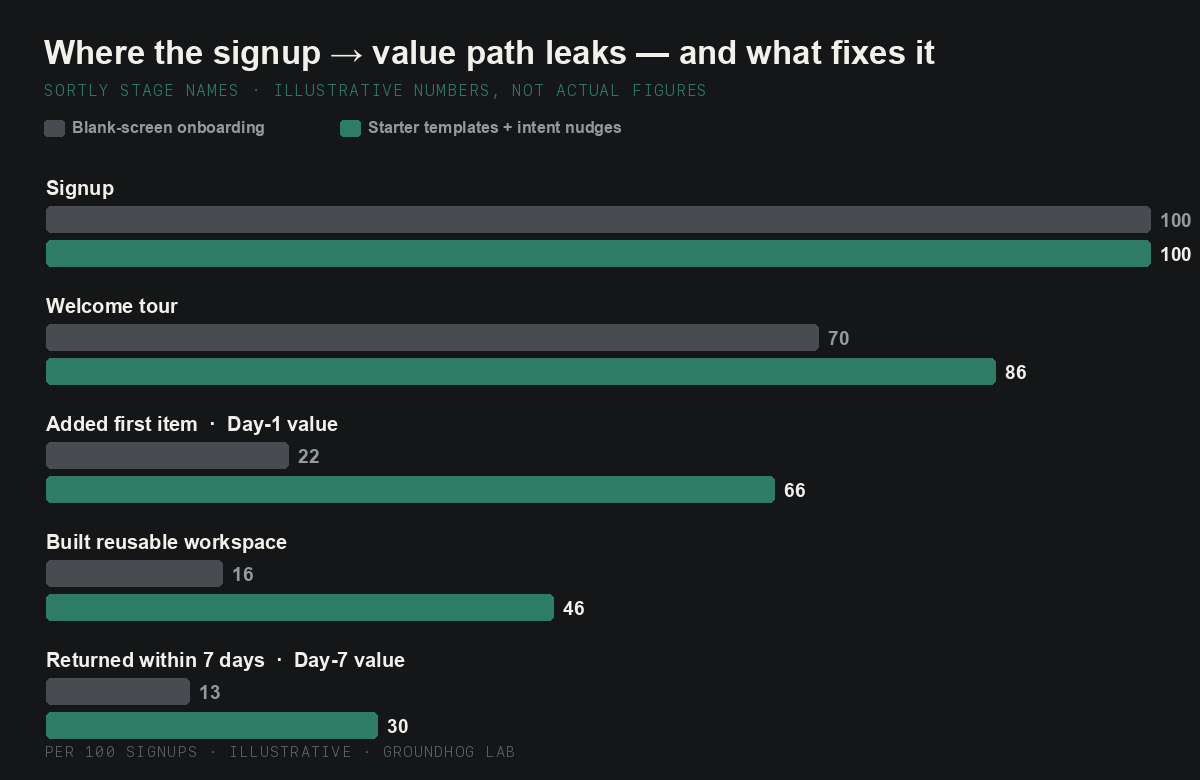
Define the actions that matter, then build the system that keeps improving them.
At Sortly, roughly this machine took Day-1 activation to 3×, Day-7 to 2×, and added 7 points of conversion year over year. It isn't a Sortly trick — the same pattern drove 3× registration and +180% invitation success at Doximity. Different products, identical move.
I'm not going to hand you our event schema or the template library — that's the build, and yours would look different anyway. But the diagnosis is usually free, and it's almost always the same: you don't have a traffic problem. You have a machine you haven't built yet.